ANZACS IN THE SOMME strong contribution during WW1
Remembering those who fought and lived through the First World War is an important part of our work.
Through commemorations, guided tours, educational projects and remembrance events, we help keep their stories alive.
Somme region /most important sites
The ANZACS in the Somme made a significant contribution to the Allied war effort during WW1, helping defend France and ultimately securing victory.
Here are some of the most important sites for you to consider for your itinerary.
THE SIR JOHN MONASH CENTRE
This immersive multimedia centre tells the story of Australian troops on the Western Front through interactive installations and engaging historical displays.
NEW: Discover the Battle of Villers-Bretonneux from a new perspective with the centre’s brand-new virtual reality experience.
THE ADELAÏDE CEMETERY
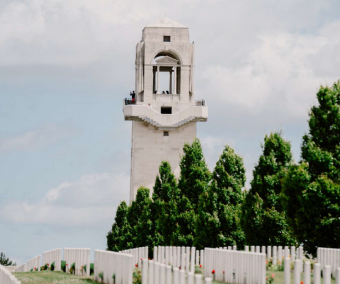
Located in Villers-Bretonneux, the Adelaide Cemetery was established in June 1918. Following the Armistice, graves from smaller cemeteries in the surrounding area were relocated here.
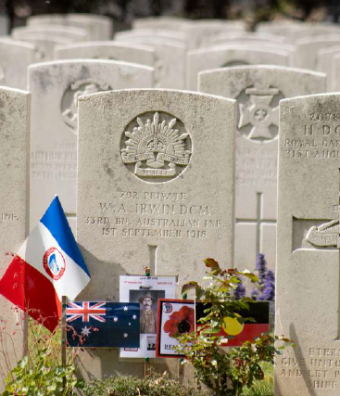
Today, the cemetery stands as a lasting reminder of the sacrifice made by Australian servicemen in the Somme region.
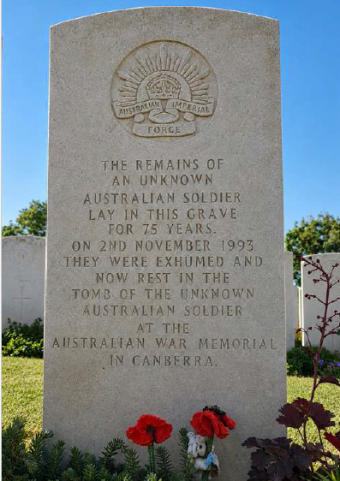
On 2 November 1993, the remains of the Australian Unknown Soldier were exhumed from this cemetery before being transferred to Canberra, where they now rest at the Australian War Memorial.
Location: Adelaide Cemetery / 119 Rue d’Amiens, 80800 Villers-Bretonneux, France
Further information: www.cwgc.org
THE AUSTRALIAN CORPS MEMORIAL PARK
Situated on the heights of Le Hamel, this memorial commemorates the Allied victory of 4 July 1918, led by Australian General Sir John Monash.
Around twenty interpretive panels explain the innovative tactics behind this remarkable battle, in which Allied forces achieved their objective in just 93 minutes through a coordinated, combined-arms strategy.
The memorial features the Australian Armed Forces badge and an extract from the speech delivered by French Prime Minister Georges Clemenceau following the victory.
Location: 4 Chemin de Sailly-Laurette / 80800 Le Hamel, France
THE THIRD AUSTRALIAN DIVISION MEMORIAL
Standing on the heights above Sailly-le-Sec, this memorial was erected in 1919–1920 to honour the service and sacrifice of the 3rd Australian Division during the First World War.
On 27 March 1918, the division’s leading battalions advanced from this position towards Heilly to defend a former French defensive line between the Ancre and Somme rivers.
Their actions took place during the German Spring Offensive, launched on 21 March 1918 following the breakthrough near Saint-Quentin. The German forces aimed to capture Amiens, a strategically important communications hub.
The Australian troops played a vital role in halting the German advance before it could reach the town.
Location: North of Sailly-le-Sec / RD1, 80800 Sailly-le-Sec, France
THE FRANCO AUSTRALIAN MUSEUM
Located on the first floor of Victoria School (built in 1927), the Franco-Australian Museum tells the story of the Australian Expeditionary Force, especially on the Western Front in 1918. It
VILLERS-BRETONNEUX: A TOWN REBUILT FROM THE ASHES
Step into the history of Villers-Bretonneux and discover how the First World War shaped the town we see today.
Once known for its thriving textile industry, Villers-Bretonneux was devastated during the fierce fighting of 1918. Explore the stories and landmarks that reveal the impact of the conflict and the remarkable reconstruction that followed.
Discover the enduring friendship between Villers-Bretonneux and Australia, forged through shared sacrifice during the war and strengthened through generations of remembrance.
Admire the impressive Saint-Jean-Baptiste Church, rebuilt in 1929 in a distinctive Neo-Romanesque-Byzantine style, and explore the town beyond the walls of the Franco-Australian Museum.
This visit provides a deeper understanding of the town’s resilience, its Australian connections and the enduring legacy of the First World War.
THE BATTLE OF LE HAMEL – AN EVENING OF REMEMBRANCE
On 4 July 1918, Australian and Allied forces under the command of General Sir John Monash captured Le Hamel in just 93 minutes. This remarkable victory became a landmark in the First World War, demonstrating the effectiveness of carefully coordinated Allied forces and innovative military tactics.
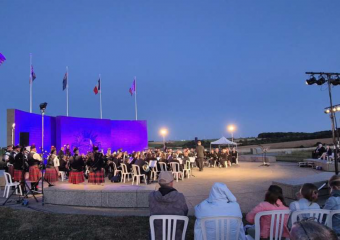
Each year, the anniversary is commemorated at sunset at the Australian Corps Memorial at Le Hamel, bringing together music, remembrance and storytelling on the very ground where history was made.
Bands, pipers and drummers perform a moving concert combining traditional brass band music with the stirring sound of bagpipes. Accompanied by a compelling narration that follows the battle minute by minute, the performance brings the events of 4 July 1918 vividly to life.
An unforgettable and atmospheric experience, offering a unique opportunity to honour the Australian soldiers who fought at Le Hamel and reflect on their extraordinary contribution to the Allied victory.
APRIL, THE MONTH of remembrance
A Lasting bond between Austrlia and the Somme region
A powerful bond was forged between the inhabitants of the Val de Somme and the soldiers who fought on these battlefields during the First World War. From shared hardship and sacrifice grew a lasting spirit of solidarity, gratitude and friendship.
Following the war, the reconstruction of the devastated villages further strengthened these ties, leaving a profound mark on the local landscape and the collective memory of its people.
Every year on Anzac Day, Australians, New Zealanders and French communities come together to honour the fallen and commemorate the shared history that continues to unite their nations.
Throughout April, Val de Somme Tourism organises the Mois de la Mémoire (Month of Remembrance), a programme of guided tours exploring the area's battlefields, memorials and places of remembrance.
These visits offer an opportunity to discover the stories behind these historic sites, deepen our understanding of the past and ensure that the courage, sacrifice and enduring friendship forged during the war are never forgotten.
A shared history. An enduring friendship. A legacy of remembrance.
Important Australian battlefield sites in France
Why is Villers-Bretonneux important to Australians?
Answer: Australian troops helped recapture the town in April 1918. The Australian National Memorial nearby commemorates Australians who died on the Western Front and have no known grave. It is one of the most significant Australian memorial sites in France.
What happened at Fromelles?
Answer: On 19 July 1916, Australian and British troops attacked German positions near Fromelles. The attack was disastrous, with more than 5,500 Australian casualties. The battle remains one of the most tragic events in Australian military history.
Why is Pozières significant?
Answer: Pozières was the scene of intense fighting in July and August 1916. Australian forces suffered approximately 23,000 casualties during the Pozières and Mouquet Farm fighting. The area is an important place to reflect on the terrible cost of the Somme campaign.
What is the Sir John Monash Centre?
Answer: It is an interpretive centre near the Australian National Memorial at Villers-Bretonneux. It tells the story of Australians on the Western Front through historical displays and multimedia experiences.
What happened at Bullecourt?
Answer: Australian troops fought two major battles at Bullecourt in April and May 1917. They attacked German defensive positions, including the formidable Hindenburg Line, and suffered heavy losses. The site helps visitors understand the difficulties of attacking strongly fortified trenches.
Practical questions for Australians travelling to the battlefields
What is the best way to visit the Australian battlefields in France?
Hiring a car or joining a specialist battlefield tour is often the most practical option, as many memorials and cemeteries are spread across rural areas. Rail travel can get visitors to regional centres such as Amiens, Arras or Lille, with further transport needed to reach individual sites.
Our recommendations: Christian recommends joining an organised, guided battlefield tour. You will save time, benefit from the knowledge and experience of registered professional guides, and gain a deeper understanding of the history and significance of the ANZAC battlefields in France. However, if you have undertaken thorough research and wish to follow your own carefully planned itinerary, an independent visit can also be rewarding.
For the ANZAC Day tour to Villers-Bretonneux, we strongly recommend booking an organised guided tour. The day involves a very early start, and access to the Australian National Memorial for the Dawn Service is subject to strict security procedures. An organised tour can help simplify transport and access arrangements, allowing you to focus on this significant and moving commemorative occasion.
Should visitors research family members who served in the war?
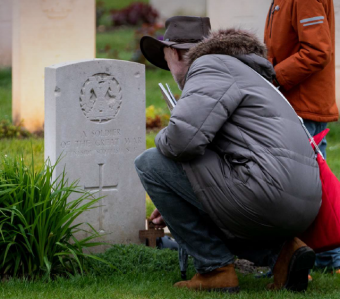
Absolutely. Before travelling, gather names, service numbers, battalions, dates of death and any family letters or photographs. Australian service records and the Australian War Memorial's online collection can help identify where a relative served and where they may be commemorated.
Our recommendations: If you know the location of a family member’s grave or the site of a specific battle that holds special significance to you, please let us know. If the location is reasonably close to our planned itinerary, we may be able to adjust the program to allow a short visit, allowing you to pay your respects and honour your family member’s memory.
What should visitors wear when exploring the battlefields?
Wear comfortable walking shoes, weather-appropriate layers and a waterproof jacket. Paths can be muddy or uneven, and some cemeteries and historic sites are exposed to wind and rain. Good mobility is essential on most of our tours.
Can visitors walk through old trenches or battlefield remains?
Some sites have accessible historic features, but access varies. Follow marked paths, obey warning signs and never enter restricted areas or touch suspicious metal objects. Unexploded First World War ammunition can still be found in the region.
Is English widely understood at Australian memorial sites?
English is commonly used at major Australian memorials and visitor centres, although not everyone in the surrounding communities speaks English fluently. Learning a few French phrases is courteous and useful.
What is a meaningful way to finish a battlefield visit?
Take a quiet moment to read the names on the memorial, reflect on the experiences of the soldiers and consider the impact of war on their families. Some visitors choose to write a short reflection or share the story of a relative with younger generations.
YOUR LOCAL PARTNER FOR TAILOR-MADE PROGRAMMES
As your australia based partner, we can help you create a meaningful and memorable programme.
From itinerary planning and reliable historical information to introductions to local accommodation providers, restaurants and tourism partners, we offer the local knowledge and connections you need to bring your programme to life.
Contact us today or check out our ANZAC Tours and packages, CLICK HERE